

Category: Elmms Gardening
Overall work involved
Gardening chatter
Hi, just a place to set up some chatter as I go along undertaking my gardening tasks within my customer’s gardens.
Plant chatter
Buying plants
Buying plants we wish to grow in our gardens can be easy and at times risky!
There’s nothing more satisfying than visiting a local garden centre or local grower, to search through and look at individual plants you really want to purchase for your garden.
Remembering the rule of ‘right plant, right place’ can sometimes be forgotten when selecting those species of plants and getting ‘carried away’ with your purchases! At least the visual ‘touchy-feely’ really helps in choosing healthy plants to grow on in your own garden.
However, what if you don’t have the ability to visit any garden centres or growers or just don’t have the free time to do this?
There’s a myriad of online suppliers who clammer to get your attention and it’s always difficult to choose one which will deliver to meet your needs when unable to inspect them first.
I’m certainly not here to state who you should or shouldn’t purchase from. Maybe personal recommendations do help and I really think it’s important to look at an individual companies returns policy if plants supplied to you don’t meet the expectations of what was suppose to be delivered. Invariably, suppliers will get it wrong and as long as there’s a satisfactory mechanism to obtain a refund then there’s a least a safety net for you, the customer.
And more so, for gardeners who don’t use the internet, ( yes, some of my customers don’t use the internet) there are gardening magazines, newspapers who will provide sufficient adverts for plant suppliers to still advertise there.
case study
One of my customers wanted to have a regimented row of annual bedding plants with pink flowers in a long raised bed which already had Spring flowering bulbs, a line of established Salix integra ‘Flamingo’ half standard trees (Flamingo Willow) and Buxus balls and pyramids growing neatly in lines along the raised bed.
Knowing already that the 11 metre long raised bed would be susceptible to drying out during periods of dry weather made worse by the line of established Flamingo Willows seeking more water as they grew, I decided to locate a pink flowering annual Pelargonium as they would cope well with drier conditions due to their originality from warmer climes.
And I knew the probability of locating 35 pink flowering Pelargoniums from local garden centres or local growers would take a lot of wasted time, I decided to search on line and discovered a grower through Thompson and Morgan seed and plant supplier who could accommodate this.
Buying ‘garden ready’ plants being delivered towards the end of May gave me confidence that on arrival, although the plants would be small, they would though be ready to plant out without delay knowing that any late frosts would have ended by then
The gardening year 2026
January to March 2026
January always starts the year quietly. The weather is a major player in what can be achieved in the garden and if inclement weather persists then it’s always best just to wait until more settled weather arrives.
Although it always seems that our gardens go to sleep, they don’t!
Should temperatures be held above 5 degrees, lawns will very slowly continue to grow and may need a light mowing, just tipping the grass blades to keep that ‘maintained’ look about them.
Elmms develops
helping customers improve their gardens
Elmms undertakes garden development. I only undertake soft landscaping works which includes planting plants and bulbs, hedges and trees.
I have often found that following on from hard landscaping constructed within a garden, it leaves their customers wondering what next to do with the soft aspect of their redesign: i.e. the planting
A visit from myself to your garden for an initial low cost meeting will include a full discussion on how the new hard landscaped garden can be planted up to provide, colour, shape, form and interest all year round.
My view is that it’s always important to meet a customer’s requirements and expectations or if unachievable then to offer alternatives that could still meet the brief overall.
As a result, gardens are greatly improved.
Small border created in back garden
A customer asked for a small border to be created within the back garden, keeping it small in size due to the narrowness and small size of the back garden. The customer just wanted an area to be able to start growing some plants to brighten up a bland space.
After agreeing the shape and using string and canes to set the width it was first necessary to carefully remove the existing turf cutting below the root zone and then removing as much soil as possible from the grass returning as much soil back to the border.


It was then necessary to dig through the new border breaking up the soil, removing any further weed roots and other ‘unwanted materials’. Following this, peat free organic matter was added to improve the soil structure, provide nutrient and water holding ability as the existing soil was totally dry. Watering the soil and adding slow release granular fertiliser completed the border ready to be planted by the customer.


Front garden space improvement (Spring 2021)
On new housing developments I find that there’s always awkward and often misshapen plots of land that are ‘gardens’ belonging to their owners. Bits of land that add little value for the owner although helps to improve the overall aesthetics of the development.
One of my customers has such a plot or garden space separating her and her neighbour’s driveways. Although small in size it has often been driven and walked over and as such the existing plants had become damaged and with the soil being trampled, just didn’t look like it belonged to anyone.
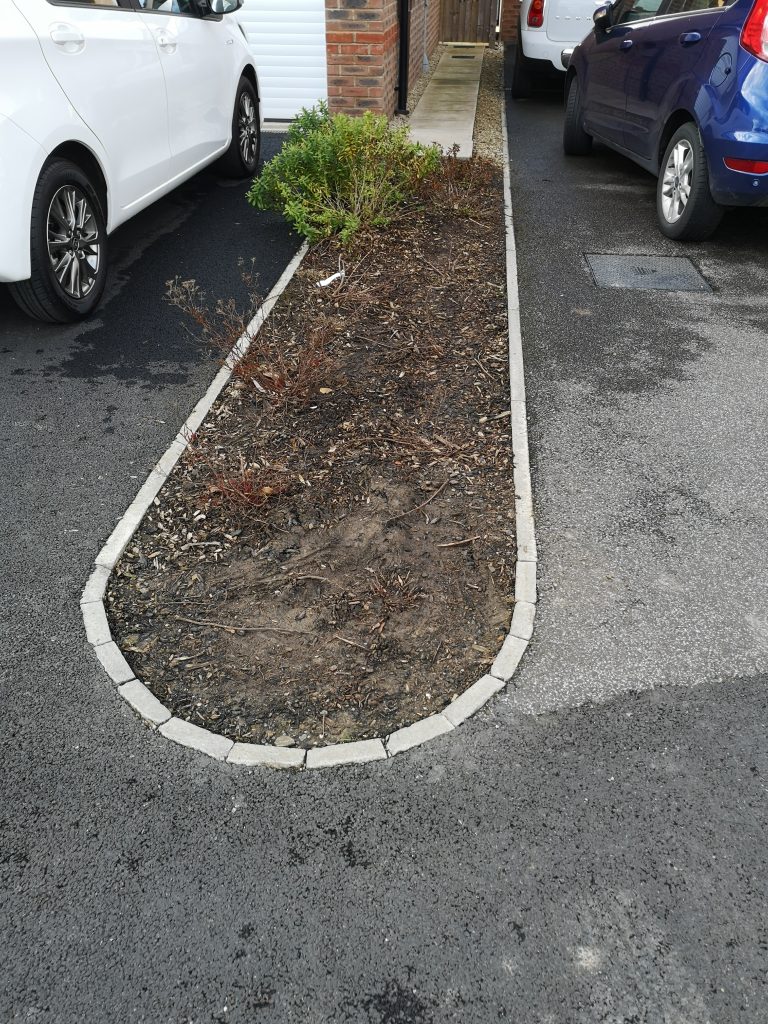
So initially, to relieve compaction a thorough cultivation was required. The large concrete haunching set behind the kerb edgings reduced the overall size of the plantable area, however enough space was available to increase some planting for the space.

In selecting appropriate plants, something more substantial, evergreen and prickly was required to give a living barrier where the bed met the tarmac roadway. I chose an evergreen Berberis julianae, a tough reliable plant which would cope with such poor conditions and be clipped to prevent it getting too big. Some existing plants were growing again within the bed, so enhancing the space with Euonymous ‘Emerald and Green’ and Lavandula spica ‘Hidcote’ would give evergreen foliage with splashes of scented purple flowers in Summer and would contrast well with the existing Spiraea ‘Gold Flame.’

Only a small planting task yet one which has greatly improved the space, has added, shape, form, colour and interest, has made it look ‘owned’ and as such will be respected and walked and driven around it in future!
Time to renew – March/April 2021
A small project within an established border provided an opportunity to thin out, prune back and in part, remove older established shrubs so injecting new life and plants into the spaces available.
My customer wanted most of the plants retaining to keep the height within the border and most existing plants being evergreen would keep an all year round interest.
The border being Southerly facing is always dry, with the soil being hard all year round and strewn with roots from the existing plants and well established trees making it difficult to cultivate.
Removing several large shrubs was a challenge:-


Replanting a rockery
An established rockery just needed some attention including weeding, thinning out, cutting back and replanting and with some new rockery plants added brought this feature back to life!


Front garden improvement
A customer asked for her front garden to be replanted to provide interest through the year. Currently the two borders contained a variety of decent and old, worn out shrubs with a helpful splash of weeds growing well on the heavy wet clay soil.
So, the starting point was to look at the planting areas and see which plants could be retained and which needed to be removed. Then checking the condition of the soil, looking at the aspect and where the sun affected the garden during the day.
The new plant selection was to provide plants which would cope with heavy wet clay soil and a westerly facing aspect. And to have a selection of plants to provide shape, form, colour and interest through each season within the bounds of the two narrow rectangular borders.
The work involved the thorough weeding and then removal of selected plants, cultivating and adding organic matter to the tightly formed clay soil in order to open up the heavy structure of the soil.


Back at base, choosing suitable plants for the garden took time yet worthwhile to get the effect required. Bearing in mind that some of the plants retained gave structure all year round, it was necessary to provide some additional evergreen plants in places to give Winter to Spring interest whilst the perennial plants had died back over the Winter months.
As the clay soil was saturated it was necessary to delay planting until the soil had dried out somewhat and once suitable, a final cultivation adding organic matter to the soil to help to open up the clay soil and the areas were then ready for planting.


My customer was delighted with the result and the choice of plants have grown really well through the year and something she has enjoyed looking out of the living room window to see what’s next in flower in her garden!
Corner garden bed planting
Just a smaller task to bring back to raised planters back to life:-


Tidying up an area


Extending an area within a garden


Elmms maintains
Elmms provides one – off or regular garden maintenance undertaking a range of horticultural tasks to meet the customer’s requirements for lawns, borders, hedges and paths at the right time of year and in the correct way.

Elmms utilises their own equipment with either petrol or rechargeable battery powered machinery and a range of hand tools suitable for good horticultural practices.
Lawns


Garden maintenance can include the regular cutting of lawns and their edges to keep that neat and tidy appearance throughout the year. Edging lawns also prevents grass species from creeping out from lawns and growing within adjoining features.
Borders


Maintenance of borders is also a regular task to keep these areas weed free. Depending on the type of weed be it annual or perennial the use of correct hand tools with help to keep weeds at bay.
Hedges
Hedges are also maintained at the appropriate time of year and considerate to nesting birds.


Caring for plants
Caring for customer’s plants is undertaken at the correct time of year, depending on the plant type and its needs.


Elmms advises
Elmms horticultural advice provides solutions to get the best from each garden.
For example, a common sight in gardens is where a variegated plant seems to be having an increasing amount of pure green growth gradually taking over.
‘Reversion’ as it is known and shown in the photograph below is where variegated plants ‘revert’ back to their pure green parentage state.

Careful, although sometimes more drastic pruning is necessary to remove all the green growth so maintaining the plant in its’ variegated state. If left, the variegated plant in time will eventually be totally green losing its’ identity as a variegated plant.
Elmms will provide sound horticultural advice on gardening problems and will gladly provide a cost to remedy the issue.
Lawns
Where possible stay off lawns in frosty/icy weather as damage to the grasses can easily happen leaving yellow footprints after the frost and ice has melted away.


Over time though the damaged lawn will recover!
Lawns suffering
Lawns are the aesthetic green blanket which sets off the borders, paved and seating areas within and around our gardens.
Made up from millions of individual grass species growing together in very close spacings between them, it’s easy to see how they can fall into a poorer state if not maintained correctly. Correct maintenance include regular mowing at the right height for the appropriate lawn and grass species which makes up the lawn, correct fertiliser used at the right time to encourage healthy grass growth in Spring and summer yet reverting to stronger root growth and hardening of grass blades in Autumn and Winter
Moss
Winter 2023 into Spring 2024 has brought exceptional prolonged and extensive rainfall to the area over much of the Winter period resulting in very wet, saturated and boggy lawns.
This has increased the amounts of moss growing within lawned areas to the point at some customer’s gardens its hard to now see where the blades of grass are!
With careful treatment it is possible to keep the moss in check using appropriate moss killing materials either in liquid or granular form whichever is appropriate for the location. There is also an appropriate brand which is safe to use and has no effect on pets and doesn’t stain hard surfaces if spilt onto them.
Leatherjackets
Reading through a lot of posts over this Winter where ideal conditions must have been present within lawns, damp and mild, so extending their feeding times, which in turn has enabled more to survive the milder Winter, for Leatherjackets to have caused extreme damage to lawns.
In my ten years of gardening as a sole trader and throughout my horticultural career I haven’t come across such devastation they cause until now!
One customer’s lawn has been destroyed through Leatherjacket activity eating through the roots and leaves of the grasses. Unfortunately a part of the small rear lawn is in shade most of the day due to the closeness of the house, adjoining garage and the lawn facing a northerly aspect which has in turn weakened the grass sward


The lawn five months earlier back in September was growing fine apart from dog urine patches across. the lawn and had been fed with Spring and Summer lawn fertiliser and mown every fortnight with the clippings boxed off and removed.

Presumably though due to low light and shade the grasses became sparser in places which allowed the infestation of Leatherjackets to take hold in a big way and causing the devastation it did within a few months.
Now there are treatments available called ‘Nemasys’ (natural leatherjacket killer) and can be used in the Autumn when the leatherjacket eggs have newly hatched and are very succeptable to the nematodes applied to the lawn. A follow up application can be made in the Autumn but the leatherjacket are much older and have a tougher outer skin which makes it hardener for the nematodes to infect. However the treatment exists as a method to help eradicate these unwanted and destructive larvae.
Whether the customer wishes to follow this method of eradication or resort other landscaping ideas remains to be seen.
Elmms restores
Restoring gardens to how they should be
At times and for various reasons our gardens can soon become overgrown, unkempt and eventually out of control.
Elmms will carefully restore such gardens to their former glory with respect for each plant species growing there. At the correct time of year this will include
- pruning
- thinning
- repairing
- dividing
- replanting
- removing
- relocating
- weeding
- cultivating
Overgrown lawns can also be bought back into a good maintained state over time through
- initial cutting and raking
- scarifying
- weed and moss treatment where appropriate
- seasonal fertiliser treatments
Finally planned regular aftercare will then keep the garden growing as it should!
The following are some examples of the work Elmms has been involved with in restoring gardens:-
Overgrown plants
A totally overgrown Honeysuckle revealed very dense and tangled growth which required careful yet severe pruning back to the main stems in order to create a better framework for this climber

Overgrown honeysuckle 
Honeysuckle hard pruned leaving many new buds to burst into growth in the Spring
At times plants can also take over too much and hide features in a garden that need to be highlighted. Below shows a stone wall at the entrance to a garden covered in Ivy which once cleared away displays the wall as it should be.


Trimmed back ivy now allowed to die back 
Cutting through many ivy stems
Overgrown garden
A totally overgrown area within a garden required some careful restoration.

It was necessary to use hand shears and loppers to cut back Bramble, Dock, Nettles and grass weeds which had extensively taken over this area of the garden.

Carefully clearing away unwanted vegetation including bramble, dock, nettle, dandelion and grass species 
Selective and restorative pruning opening up the garden
Following cutting back, these unwanted weeds were traced back and dug out to minimise regrowth. Although remembering that ‘one year’s seed equals seven years seed’ then regular planned maintenance would follow including appropriate seasonal pruning and shaping of plants to prevent this area from becoming overgrown again.
Elmms takes great care with the work undertaken. If a brush cutter had been used to clear out this area, then, yes, it would have been quicker but at the expense of many plants growing within this tangle of vegetation.

And finally as a reward Muscari surfaced and flowered again after many years of being unnoticed much to the delight of the customer!
Overgrown lawn
Lawns need regular maintenance and between March through to November keep growing.
Lack of regular cutting soon sees a lawn overgrown and untidy. Elmms can soon transform overgrown lawns and to bring them back into a maintained state.

lawn now in a more maintained state 
overgrown lawn
Lawn repairs
Damaged lawns can be repaired by using turf or grass seed but using such may not match the existing lawn due to the make up of the grass unless some existing lawn is lifted and reused.
Depending on the damage could simply mean adding some sieved soil and/or compost and letting the grasses grow through. Where more extensive damage has been caused may need the soil replacing and new turf or seed adding.
The following shows an area where an u known substance has been tipped on the lawn causing damage requiring the dead grasses being removed, soil cultivations and new soil/compost adding and then grass seeded over.


Path restore
Paths all need regular maintenance to keep them weed, moss and algae free to keep them clean and safe to walk on.
Scraping off the build up of material initially, then brushing and an approved path surface cleaner followed by a final rinse and brush creates a clean and safe surface to walk on.

Path after cleaning 
Path covered in moss and algae
Elmms contact details
Opening hours
Elmms is open for business Monday to Friday, 09.00 to 17.00 inclusive.
Business address
Elmms is based in Barlby, North Yorkshire.
Phone
Elmms phone number is 07548977537.
If unavailable, please leave a short message and I will contact you on my return.
Elmms email address is elmms@outlook.com